This blog post is part of a series highlighting innovative Seattle IT projects shaping across the City of Seattle organization. Each installment will offer a behind-the-scenes look at the work of various teams, the challenges they’re tackling, and the solutions they’re building to improve experiences for staff and the communities we serve. In the second installment of this series, the Service Design Team discusses how they worked to improve employee performance management processes for Seattle IT employees.
In January 2025, the City of Seattle decentralized employee performance management. Seattle IT saw an opportunity to build an in-house solution that was cost-effective, optimized for our department’s business rhythm, and customized to support our departmental goals. The Service Design team was brought in to support the effort, seeking to strike a balance between functionality and simplicity. Because the expected lifespan of the solution was uncertain – it could be short-term or long-term – we aimed to avoid over-engineering it while still meeting core needs.
Defining the need
The Service Design team was brought in to support the Organizational Change Management (OCM) team’s development of new performance management practices by generating interface designs and mapping process flows that matched the Annual Performance Review process devised by OCM. These designs included flows and features for employee self-assessments, manager reviews, and HR evaluations.
Built using Microsoft PowerApps, the application was designed to support Seattle IT’s growth as a learning organization by encouraging knowledge creation at all levels. Additional parameters included:
- Accommodating goal tracking and supporting forward growth milestones.
- Providing clarity on performance standards and expectations, including identifying areas for improvement, skill refinement, and development opportunities.
- Motivate employees by helping them understand how their work aligns with the organization’s goals.
Early prototype and scoping the consultation
The OCM team had worked with a developer to build an early PowerApp prototype of the Beacon annual review process. The Service Design team reviewed this prototype to evaluate stakeholder expectations and assess project scope. To scope the consultation, we:
- Facilitated informational interviews with subject matter experts (SMEs) to understand the updated process.
- Compiled process flows of key tasks to identify critical screens for design generation and testing.
- Conducted a competitive analysis of similar products to spark design ideation.
Data synthesis and generating personas
Prior to engaging with Service Design, the OCM team conducted focus groups with key user groups, including people managers and HR business partners. In these sessions, participants provided input on the proposed process changes and shared their expectations for a modernized performance management system. The service design team then:
- Reviewed focus group session notes and pre-consultation assets.
- Affinity-mapped data to identify trends, needs, and pain points.
- Developed user personas grounded in focus group data and qualitative insights.
Designing and prototyping
Synthesizing the user personas, competitive analysis, and feature requests, the team held a rapid ideation session to sketch potential interface designs. We shared concepts, voted on core features, and incorporated the prioritized elements into a mid-fidelity prototype.
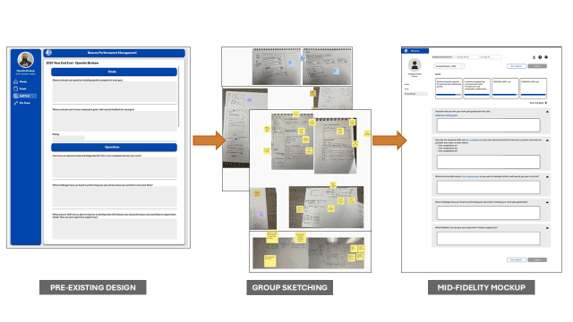
Throughout this process, the project team collaborated closely to ensure alignment across technical needs, process requirements, and HR compliance guidelines.
Testing the prototype with users
To evaluate the efficacy of the design solution and understand if it aligned with user expectations, we conducted moderated usability tests with 10 Seattle IT employees (a mix of individual contributors and managers). We observed how participants navigated the product, identified key pain points and uncovered opportunities to enhance overall user satisfaction. These insights directly informed product refinements for the next iteration of Beacon.
Individual contributors and managers were asked to complete tasks relevant to their respective workflows, including:
- Discussing their familiarity with annual reviews, impressions of the previous system, and their goals when managing self-assessments for themselves or their team (if managers).
- Starting a self-assessment, saving their progress to return later, and finishing and submitting the assessment.
- Reviewing and signing off on the review.
- Rating their overall confidence in navigating the annual review process within the new system.
Key usability findings and how we addressed them
Overall, most participants successfully completed the annual review tasks in Beacon with several noting that the interface “felt easier and more intuitive” than E3. However, testing highlighted two primary areas requiring refinement:
Finding 1: Unclear purpose of the goals informational component
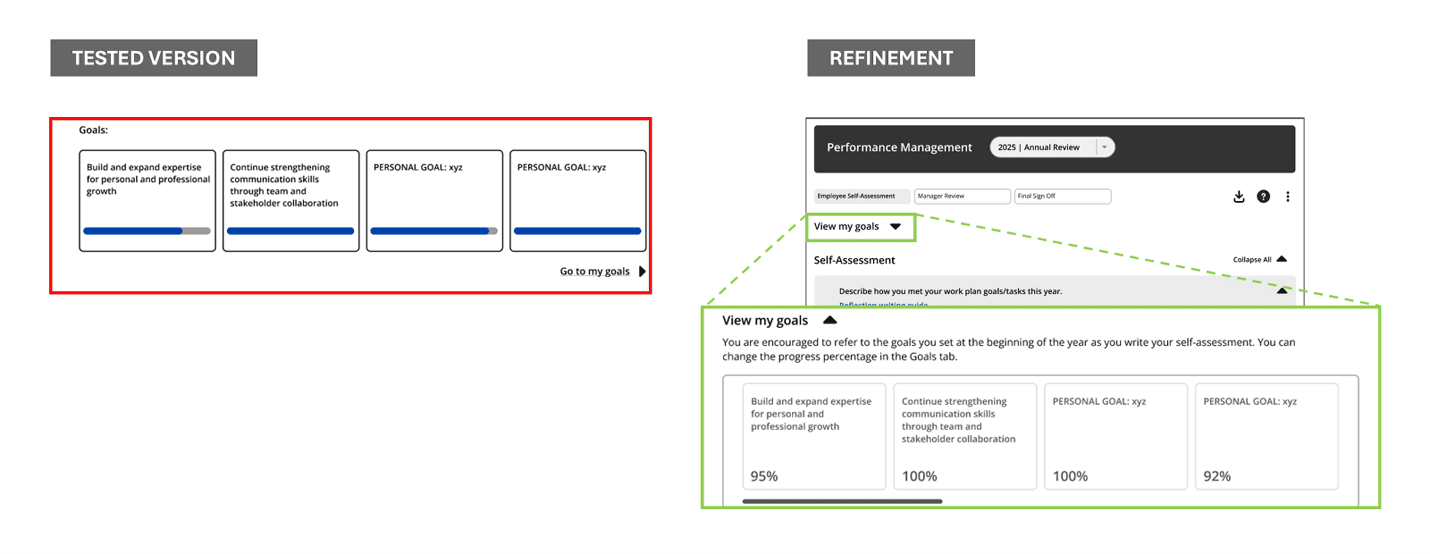
Insight: 70% of test participants reported expecting to interact with the goal tiles at the top of the page. Additionally, most users associated the first question “Describe how you met your work plan goals/tasks this year.” to the tiles, rather than perceiving them as static reference items.
Feedback:“I’d want to be able to click on a goal, talk about it, and then go to the next. But here there’s only 1 box to address all of them.” – Individual contributor
How We Addressed It:
- Reduced visual prominence of the component by removing color and using a softer grey to make it look less “interactable”.
- Hid the goals by default with the option to expand them to view them and added a horizontal scroll to accommodate all goals.
- Added a short explanation to explain why goals are shown here and that users cannot interact with them on this page.
Finding 2: Users reported wanting to know what would happen after they submitted
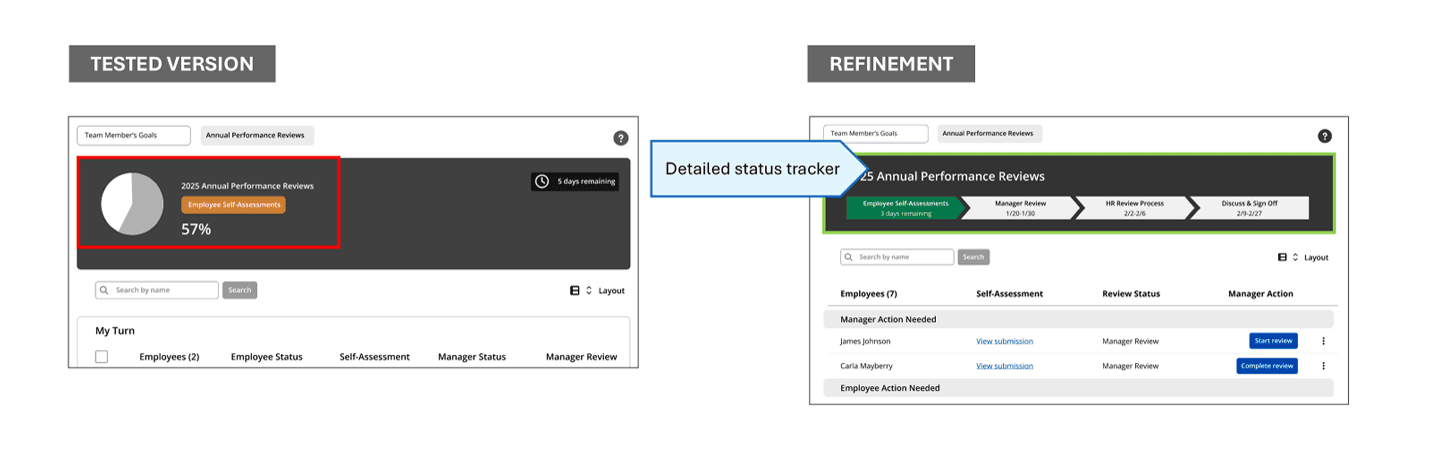
Insight: 70% of participants reported they would want to track the status of their review through final completion.
Feedback: “If I were able to see if my review had been edited or viewed [by my manager] that would be nice. Honestly, it feels like it goes into the abyss.” – Individual contributor
How We Addressed It:
- Implemented a progress step tracker and current status indicator in an application header for both employees and managers:
Designing and implementing the final product
We refined the Beacon prototypes based on usability testing and documented out-of-scope feature requests for future iterations. Working alongside the developer, we supported the technical build and final rollout.
Impact metrics
The Beacon Annual Review module achieved high engagement. The OCM team reported a 90.4% self-assessment completion rate among staff (+6.4% from 2024) and a 94.1% review completion rate among managers (+1.1% from 2024).
Qualitative impact
Since launching Beacon, multiple city departments have expressed interest in adopting Seattle ITs human-centered model for their own performance management process. While Beacon was custom-built around Seattle IT’s specific organizational process and needs, Seattle IT is actively collaborating with partner departments to support them in exploring their options to modeling their framework or adapting this framework to support their own unique performance management workflows.
What Comes Next
Following the successful launch of the annual review module, the Service Design team continues to partner with OCM to design and roll out future performance management modules, including quarterly alignment sessions and goal-setting features, which have been rolled out in 2026 or are in progress and slated to be released before the end of the year.
Zhen Zhen McMahon is a member of the Service Design team and previously worked with ITD Digital Engagement as a User Experience designer. In her work with the City of Seattle, she uses human-centered design methods to improve public and internal-facing tools and processes, helping align organizational goals with the needs of residents and staff.